
Tool selection Punching tools
How to choose die clearance for CNC punching
The calculation formula, a clearance table by material and thickness, and why total clearance, not per-side clearance, is what actually matters.
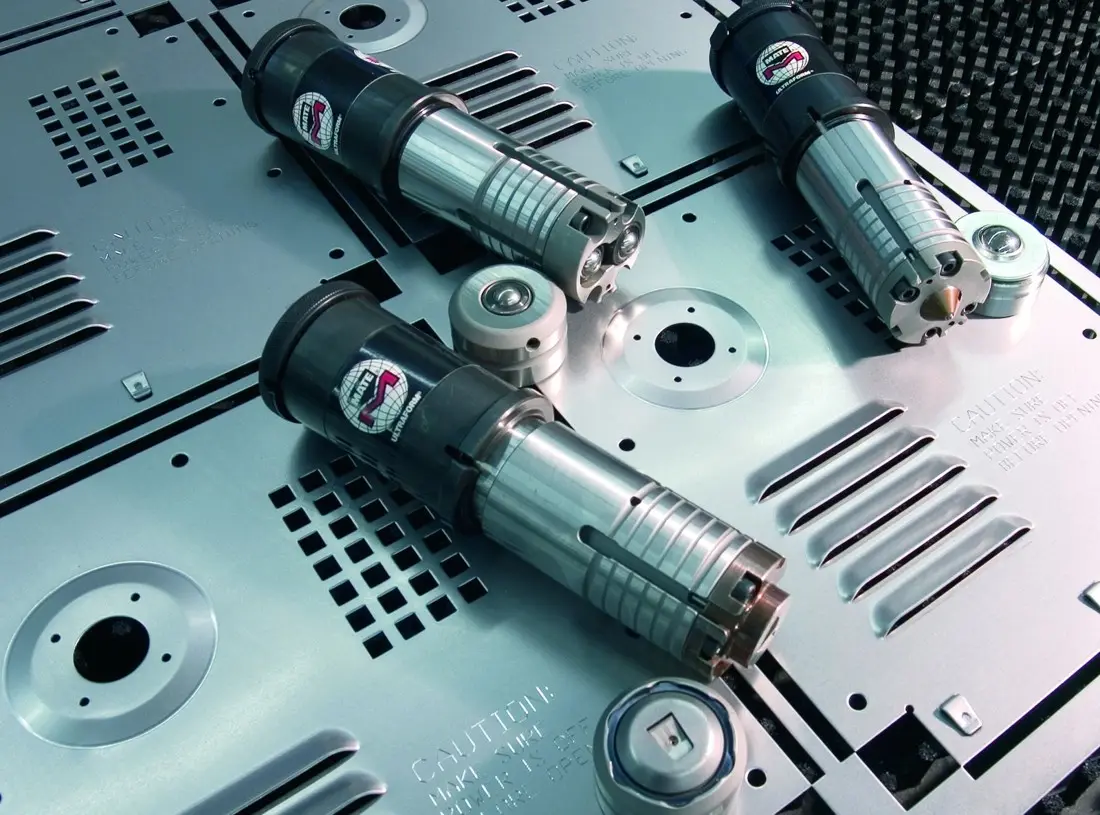
Wrong die clearance costs twice: once through punching force and tool wear, and again through the burr left on the part. The formula and table below apply regardless of who made the tooling. Where we have a specific Mate recommendation, we call it out separately.
What die clearance is
Die clearance is the gap between the punch and the die, on each side, at the point where the punch enters the die opening. The basic formula for die size:
Die size = Punch size + Total die clearance
Total die clearance is calculated as a percentage of the material thickness: Total die clearance = f × material thickness, where f is a factor that depends on the material being punched.
Example: a 10 mm round punch working in 1.5 mm mild steel, with f = 0.2, needs a die sized 10 + 0.2 × 1.5 = 10.3 mm. Total die clearance is 0.3 mm.
A common mix-up: total clearance, not per-side clearance
Total die clearance is the sum of the clearance on both sides of the punch, not the clearance measured on one side alone. This mix-up produces out-of-tolerance parts when someone sizes the die from per-side clearance instead of total clearance. Always check which value your machine documentation or tooling supplier is using before ordering.
Recommended clearance by material and thickness
The table below comes from the Mate Precision Tooling technical catalog and covers both piercing and blanking:
| Material | Sheet thickness | Total clearance — piercing | Total clearance — blanking |
|---|---|---|---|
| Aluminum | under 2.5 mm | 15% | 15% |
| Aluminum | 2.5–5.0 mm | 20% | 15% |
| Aluminum | over 5.0 mm | 25% | 20% |
| Mild steel | under 3.0 mm | 20% | 15% |
| Mild steel | 3.0–6.0 mm | 25% | 20% |
| Mild steel | over 6.0 mm | 30% | 20% |
| Stainless steel | under 1.5 mm | 20% | 15% |
| Stainless steel | 1.5–2.8 mm | 25% | 20% |
| Stainless steel | 2.8–4.0 mm | 30% | 20% |
| Stainless steel | over 4.0 mm | 35% | 25% |
The percentage is of material thickness, not a fixed millimeter value. The same 25% means a larger clearance on a thicker sheet.
Piercing versus blanking
The two applications use different percentages because the priority is different. In piercing, the finished part is what’s left around the hole, so the larger clearance in the table is acceptable in exchange for less tool wear. In blanking, the finished part is the piece that falls through the die, so a tighter clearance is preferred for a cleaner edge on the contour that actually matters.
What goes wrong with the wrong clearance
Correct clearance lets the shear cracks starting from the punch and from the die meet partway through the material thickness, which balances punching force, hole quality, and tool life. When clearance is too small, the cracks don’t meet cleanly: secondary shear cracks form, punching force rises, and the tool wears faster. When clearance is too large, punching force drops, but the burr left on the part grows noticeably and the hole edge becomes less clean. Choosing clearance is really a trade-off between these three effects, force, edge quality, and tool life, not a single universal “optimal” number.
The minimum clearance possible depends on your machine
The table above gives recommended clearance for normal operation, not the absolute minimum clearance achievable. How small clearance can actually go depends on how precisely your punching machine aligns the punch and die, a value specific to each machine model and its wear condition. Check your machine’s documentation for the real limit before designing tooling at the edge of the table’s minimum clearance.
Mate’s answer: SLUG FREE® dies
For applications where burr and slug buildup inside the die are a recurring problem, Mate offers SLUG FREE® dies, designed to prevent the punching waste from jamming inside the die. Regardless of sheet thickness, the recommended punch penetration into a SLUG FREE® die is 3.0 mm, a fixed value, not a percentage like clearance itself.
What to send us
For a concrete clearance and tooling recommendation, the fastest way is to send us:
- The material and thickness of the sheet being punched.
- Whether the application is piercing or blanking.
- The make and model of your punching machine.
- Whether burr on the resulting part is a known problem today.
Compatibility checks are free and come with no obligation, before any quote.
See the full Mate CNC punching tooling range → Contact us for a recommendation →
Source: Mate Precision Tooling technical catalog (“Die Clearance and Hole Quality”), for the clearance table, calculation formula, and SLUG FREE® dies. Updated: August 24, 2026.