
Maintenance & operation Cutting & welding consumables
Laser cutting table cleaning: why dross sticks to the slats and how to keep it under control
Why dross welds itself to laser table slats, what a dirty table costs, how often to clean and replace slats, and what reduces buildup, from nesting to 3YO TS protection.
On a laser cutting machine, the table is the part nobody thinks about until it starts getting in the way. The slats support the sheet, and the molten metal leaving the kerf lands on them or falls between them. Over time, dross builds up on the slat teeth, the sheet no longer lies flat, small parts get caught, and the machine stops for cleaning. The mechanism is the same whatever the machine brand, and so are the remedies.
Why dross sticks to the slats
During cutting, the assist gas blows the molten metal down through the kerf. The droplets solidify very quickly, in the air or on contact with a slat. Those that land on a slat stick in three places: in the valley between the teeth, on the flanks, where they thicken the slat, or on the tooth tip, right where the sheet rests.
How hard the dross is to remove depends mainly on three things:
- Laser power and plate thickness. High-power fiber lasers cut thick plate fast and eject a lot of molten metal. The resulting dross is close to pure metal and ends up practically welded to the slat.
- Assist gas. With oxygen cutting, dross is softer and relatively easy to clean. Nitrogen leaves harder dross, and nitrogen-oxygen mixes or dry compressed air make it harder still to remove.
- Repeated cut paths. When the same nest runs for hours, the beam passes over the same points of the same slats every time, and buildup grows fast right there.
On older CO₂ lasers, dross was fluffier and came off easily by mechanical means. That is why many shops moving to a high-power fiber laser only find out after installation how much time the table demands.
What a dirty table costs
Dross on the slats is not just a housekeeping issue. The effects show up in production:
- The sheet no longer lies flat. Buildup lifts the sheet at some points, the focal distance varies across it, and cut quality drops: burrs, rough edges, dimensional deviations. The effect is most visible on thin sheet.
- Tipped parts and collisions. Small parts and slugs catch on dross or tilt, and the nozzle can hit a raised part.
- Back reflections toward the cutting head. Buildup can reflect laser radiation back toward the head, putting the protective window, the nozzle and, in severe cases, the cutting head itself at risk.
- Automation jams. On lines with automatic unloading, the sheet can weld itself to the dross on the slats. The forks then lift the slats too, and the line stops.
- Slats replaced too often. Once dross can no longer be removed, the slats are scrapped. A new set means steel, machine time to cut the slats, and time to fit them.
- Machine hours lost. On a machine with a single table, every cleaning stops production. With a pallet changer, cleaning can run in parallel with cutting, but it still takes operator hours.
- Hard, risky work. Slats are cleaned next to the machine, with sharp edges and hot dross, often with a chisel and hammer.
How often to clean the slats and when to replace them
There is no interval that fits every shop. The rhythm depends on power, plate thickness, gas, and the number of shifts. A few practical reference points:
- The more often you clean, the easier it gets. Fresh dross comes off far more easily than layers built up over weeks. Left too long, it can no longer be cleaned at all.
- A reference from practice. In shops running two shifts a day, five days a week, cleaning once a week is a common rhythm. With lasers of 15 kW or more, more and more shops clean every shift (examples cited by the American trade magazine The Fabricator).
- Clean when you change material, for example between carbon steel and stainless, to avoid contamination.
Signs that a slat set needs replacing:
- dross no longer comes off, even with a slat-cleaning tool or machine;
- the tooth tips are worn down, the sheet sits lower than it should, and the operator corrects the focus more and more often;
- slats are bent or broken.
Planned replacement, after a set number of cleanings, makes cutting more repeatable than waiting for a slat to fail.
Cleaning methods compared
| Method | How it works | Advantages | Limits |
|---|---|---|---|
| Manual (chisel, hammer, brush) | Dross is broken off and scraped slat by slat | No equipment needed | Slow and tiring, injury risk, can’t handle welded dross |
| Slat-cleaning machine | Toothed rotary cutters run along both faces of the slat | Much faster, even result | Upfront cost, wearing parts, the table is still out of service |
| Slat replacement | The worn set is removed and a new one fitted | Table as new | Steel, cutting and fitting time for every set |
| Anti-adhesion protection | A liquid applied to the table keeps dross from bonding to the slats | Fewer, shorter cleanings | Needs periodic reapplication and doesn’t eliminate cleaning entirely |
How to reduce buildup before it starts
Cleaning deals with the effect. A few habits reduce the cause:
- Account for the slats when nesting. Some nesting software shows the slat grid. On a large order that runs for hours, it is worth shifting the part layout so long cut paths don’t run directly over a slat, even at a small cost in material.
- Remove slats you don’t need. With large, heavy parts, fewer slats mean fewer points exposed to molten metal and slugs that fall through more easily. It doesn’t work on thin sheet: small parts need support.
- Rotate the slats. Move slats from front to back and vice versa, or turn them 180° in the same slot, so the same zones don’t catch the same dross every time.
- Choose the right slat. Copper slats conduct heat far better, hold less dross, and clean more easily. For thick plate, thicker slats with deeper valleys between the teeth give dross room to collect away from the tip.
- Protect the table after every cleaning with an anti-adhesion liquid, so new dross no longer welds itself to the slats.
Protecting the slats with 3YO TS
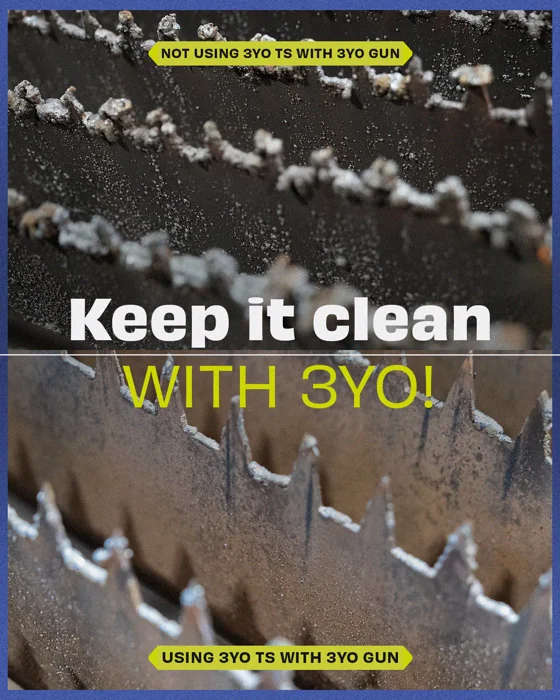
3YO TS (Total Shield) is 3YO Technology’s liquid for laser cutting tables. It is sprayed onto the table with the 3YO GUN applicator and covers both the slats and the recovery area beneath the table. According to the manufacturer, it is not the liquid itself that protects: on contact with heat, its dry components form an invisible film that leaves no residue and has no effect on plating, anodizing, or powder coating of the parts.
What the manufacturer says about use:
- Application: about 5 minutes, exclusively with the 3YO GUN. Cutting can start right after application, and up to 3 days can pass between application and the first cut.
- Frequency: one application every 325 operating hours and at least every 4 weeks, because the film is biodegradable, plus one application per new slat set.
- Dose: for example, 320 ml per application for a 3,000 × 1,500 mm table. The full table of doses by table size is in the 3YO TS savings calculator.
- Where it was tested: on fiber and CO₂ lasers; cutting mild steel, galvanized steel, stainless, and aluminum; on steel, copper, or aluminum slats.
- Formulation: natural-based, hydrocarbon-free, tested according to OECD 301B (readily biodegradable).
3YO also states the effects it stands behind: slats lasting 3.5 times longer, 3 times fewer cleanings, each 2.5 times shorter, and 70% fewer stops from caught parts and buildup. These are the manufacturer’s figures, based on field statistics, not a guarantee. You can check them against your own shop’s numbers in the 3YO TS savings calculator, which also has a prudent scenario at only 75% of the stated effect.
3YO TS, together with the 3YO GUN applicator, took second place at the EuroBLECH Award 2024, in the cutting technology category.
An anti-adhesion liquid doesn’t abolish cleaning: dross still falls on the table, but it bonds more weakly and comes off more easily. Careful nesting, slat rotation, and timely cleaning still apply with it.
For plasma and oxy-fuel tables, 3YO offers the RS (Recovery Shield) variant, covered in the article on slag on plasma and oxy-fuel cutting tables. Lang & Sin is an authorized 3YO Technology distributor in Romania, and the full range is on the page for 3YO consumables for laser cutting, welding, and maintenance.
In short
- Dross welds itself to the slats mostly with high-power lasers, with nitrogen or mixed-gas cutting, and on repeated cut paths.
- A dirty table costs cut quality, tipped parts, risks to the cutting head, new slats, and machine downtime.
- Clean often, before the dross hardens, and replace slats on a schedule.
- Careful nesting, slat rotation, copper slats, and anti-adhesion protection reduce buildup at the source.