
Tool selection Press brake tools
UKB press brake tool steel selection
Which materials UKB press brake tooling uses, which system each is available for, what hardness the bending radii get, and how to choose based on your application.
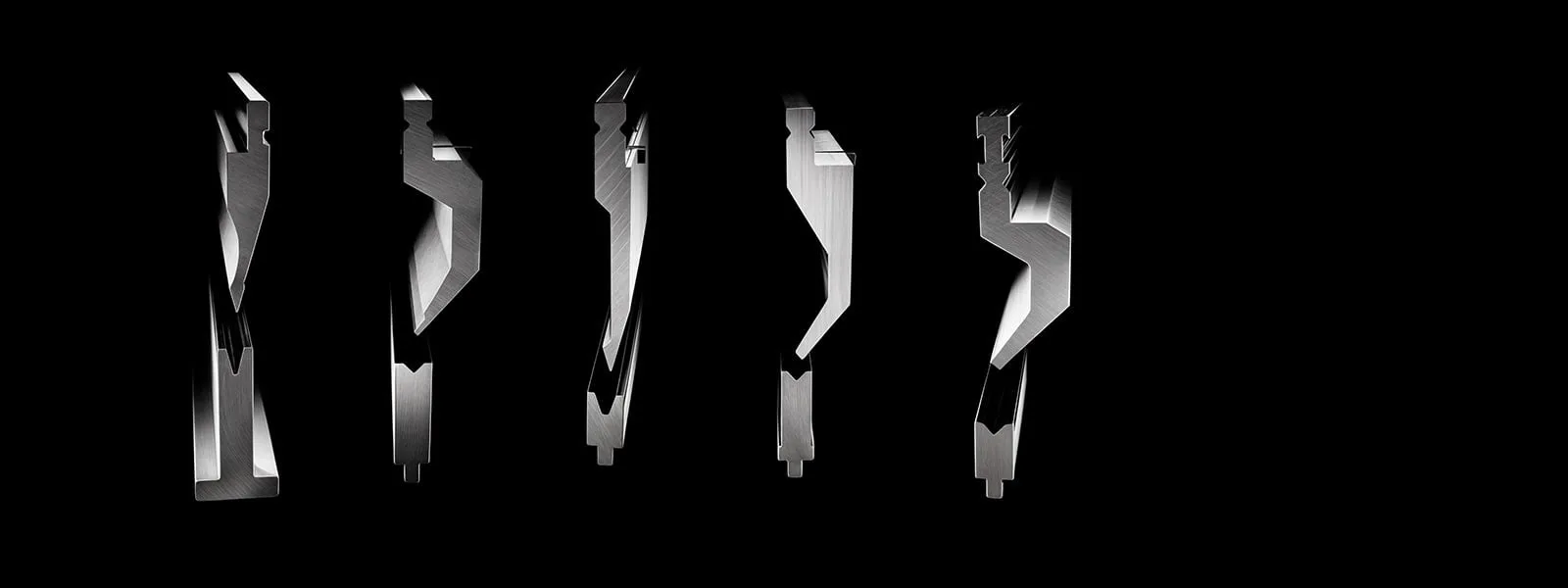
When you order punches or dies for a press brake, tool material is not a data-sheet detail. It determines how long the tool lasts under load and how accurate the bend stays over time. This guide explains the materials UKB GmbH uses, which system each is available for, and how to choose between them, based on the UKB catalog.
Materials, by system
Which material is available depends on your machine’s system. Not all four materials are available for every system.
For the standard systems (Amada, Trumpf, Wila, Bystronic, LVD), the UKB catalog lists:
| Material | Strength (Rm) |
|---|---|
| 42CrMo4 | hardened to 1,100–1,200 N/mm² |
| C45 | hardened to 800–850 N/mm² |
| C45 | 650–800 N/mm² |
The bending radii on these systems are hardened to 52–55 HRC, and the standard tools ship from the manufacturer’s stock.
For the EHT, Weinbrenner, and other non-standard systems, the UKB catalog adds a fourth material:
| Material | Strength (Rm) |
|---|---|
| 42CrMo4 | hardened to 1,100–1,200 N/mm² |
| C45 | hardened to 800–850 N/mm² |
| C45 | 650–800 N/mm² |
| 1.2312 | hardened to 950–1,100 N/mm² |
On these systems, the bending radii are hardened harder, to 55–58 HRC, and the tools are made individually to your specifications rather than shipped from stock.
Rm (ultimate tensile strength, in N/mm²) describes the material: the higher Rm is, the better the steel resists repeated loading before it fails. Rm is not the force the finished tool can take. That also depends on the tool’s geometry (angle, V-opening, height H), not just the material. The rated force is listed separately, for each product in the catalog.
What else UKB construction guarantees
Beyond the material, UKB tools are:
- Precision ground: tight tolerances along the whole length.
- Guaranteed interchangeable: a new segment fits the existing ones without adjustment.
- Guaranteed parallel: essential for an even bend along the whole length.
How to choose based on your application
The questions that decide the right material:
- What system do you have? The standard systems (Amada, Trumpf, Wila, Bystronic, LVD) do not use 1.2312. That material is specific to EHT, Weinbrenner, and other non-standard systems.
- How high is the bending force? Thicker or harder sheet loads the tool more than thin, soft sheet. At high loads, 42CrMo4 is the safe choice, within what your system offers.
- How often do you use the tool? For intensive production, the stronger material and hardened radius extend the interval between regrinds.
- What’s the budget versus the service life? C45 covers everyday applications at a lower cost; 42CrMo4 costs more but withstands higher loads.
If you send us your machine’s system, and the thickness and type of sheet you’re bending, we’ll check the right material and configuration, free of charge and with no obligation. Standard tools ship from the manufacturer’s stock in Germany, in 5 to 7 business days; tools for non-standard systems are made individually, with the lead time stated in the quote.
See the complete UKB press brake tooling range → How to choose the right press brake tooling → Contact us for a material recommendation →
Source: the UKB GmbH catalog. Updated: August 21, 2026.