Tool selection Press brake tools
How to choose the right press brake tooling
The criteria that decide the right press brake tool: press system, production run, V-opening, grain direction, and part geometry.
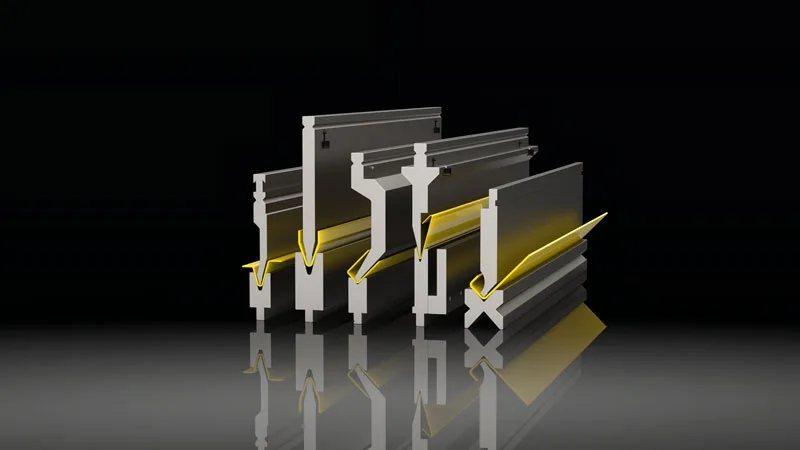
The wrong bending tool costs twice: once at purchase, and again in production, through burrs, marks, collisions, or rejected parts. The criteria below decide the choice regardless of who makes the tool. Where we have a concrete UKB solution for a criterion, we mention it, but the questions themselves apply to any press brake tooling.
1. The press’s clamping system
The first filter is mechanical, not technical: the tool has to physically clamp onto your press. The most common standards are Amada, Trumpf, Wila, Bystronic, and LVD, plus a range of non-standard systems specific to certain press manufacturers. A tool that looks excellent on paper but doesn’t match your clamping system won’t fit, check this before any other criterion.
UKB covers the standard systems above, plus non-standard systems such as EHT and Weinbrenner. Your press’s make and model are enough to identify it.
2. Production run
A question that’s often overlooked: how many parts will you produce with this tool? A special tool costs more than a standard one, but if the production run is large enough, the cost per part can end up lower than a manually adjusted standard tool at every setup. If the run is small, an expensive specialized tool never pays for itself in production. This calculation, tool cost divided by part count, compared against payback time, is worth doing before you choose, not after.
3. Standard, modified, or special tooling
Once you know the system and the run size, the central technical question follows: can the part be bent with a standard catalog tool? Standard tools are usually cheaper and have a much shorter lead time, because they’re held in stock. If no standard tool covers the part’s geometry, the options are a modified standard tool or a fully custom one, designed from your part drawing.
At UKB, this difference is concrete: tooling for the standard systems (Amada, Trumpf, Wila, Bystronic, LVD) is held in stock at the manufacturer and reaches Romania in 5 to 7 business days. Tooling for non-standard systems is made individually, with the lead time stated in the quote.
4. Material and thickness
It’s not just thickness that matters, the material type does too. Steel, stainless steel, and aluminum behave differently at the same thickness, some tool configurations produce cracks in one material that would bend without issue in another. The material available for a given tool often depends on the system, it isn’t a free choice from a complete catalog.
We’ve detailed exactly which material and hardness match each UKB system, with the full table, in the separate guide choosing UKB tool steel: 42CrMo4, C45, and 1.2312.
5. V-opening, minimum bend leg, and bend radius
These three are linked, not independent. The die’s V-opening determines both the minimum leg length you can bend and the inside radius you get, an opening that’s too small won’t accommodate the material thickness without exceeding the tool’s or press’s rated force; an opening that’s too large can’t produce a small radius or a short leg. Check these three values together, not one at a time.
For production with many different parts, a fixed-V die means frequent tool changes. UKB’s adjustable dies cover four opening ranges (V25-125, V65-185, V120-300, V150-400 mm) by swapping blades, not the whole die, with hardened rotating rollers that reduce bending marks.
6. Grain direction
For some materials, and at certain ratios between thickness and bend radius, the sheet’s rolling grain direction matters to avoid cracking at the bend, especially on tight radii or less ductile materials. If your application is near the limit on radius or material, check this before punching or cutting, since it may require a specific part orientation on the sheet (nesting) starting from the previous operation.
7. Marking and sensitive materials
If you’re bending galvanized sheet, aluminum, stainless steel, or pre-painted surfaces, where a mark from the die shoulders isn’t acceptable, a standard tool isn’t necessarily the answer. UKB has a few options built for exactly this:
- WingBend PLUS: a die with a slider that avoids bend marks on the sheet and tool contamination when bending galvanized sheet or aluminum.
- UniBend: minimal marking on short flanges, suited to diagonal and conical bends, with repeatable results from part to part.
- PU holders and inserts: polyurethane inserts, available in three hardnesses (Shore 80A / 90A / 95A), suited to aluminum, stainless steel, and painted surfaces, with no rework on parts.
- Protective films: prevent both bending marks and die contamination, universal use on all die types.
Full details, with their catalogs, are in the UKB special solutions section.
8. Part and machine geometry
A few more questions, easy to overlook until they become a problem in production:
- Press opening. Does the machine have enough daylight between the beams for the largest bend you’ll make?
- Cascading bends. On parts with multiple bends, are the dies tall enough for the already-bent flanges, without colliding with the ram, table, or backgauges?
- Existing features on the part. Does the tool need relief (local milling) to clear screws, embossed features, or other elements already formed on the part?
- Forming boxes. When bending a box with walls, the punch’s end extensions (horns) need to be sized to avoid colliding with the already-bent walls, a detail that’s often missed until assembly.
- Tall tools versus extensions. For some configurations, taller tools are more cost-effective; for others, adapters or height extensions on existing tools are. It depends on your part mix, not a universal answer.
None of these questions has a generic answer, they depend on your part and your machine. The most efficient approach is having them ready before requesting a quote.
What to send us
For a concrete recommendation, the fastest path is to send us:
- Your press’s make and model.
- The material, thickness, and production run.
- A part drawing, if the geometry is complex or the part has cascading bends.
- Whether bend marks are a problem for your application.
Compatibility checks are free of charge and with no obligation, before the quote.
See the complete UKB press brake tooling range → Choosing tool steel: 42CrMo4, C45, and 1.2312 → Contact us for a recommendation →
Source: the UKB GmbH catalog for system, material, and product specifications; general sheet-metal-forming principles for the geometric relationships (V-opening, radius, grain direction). Updated: August 23, 2026.