
Tool selection Punching tools
CNC punch tool maintenance: sharpening, coatings, and tool life
When to sharpen, the correct sharpening procedure, coatings for difficult materials, and the external factors that shorten punch and die life.
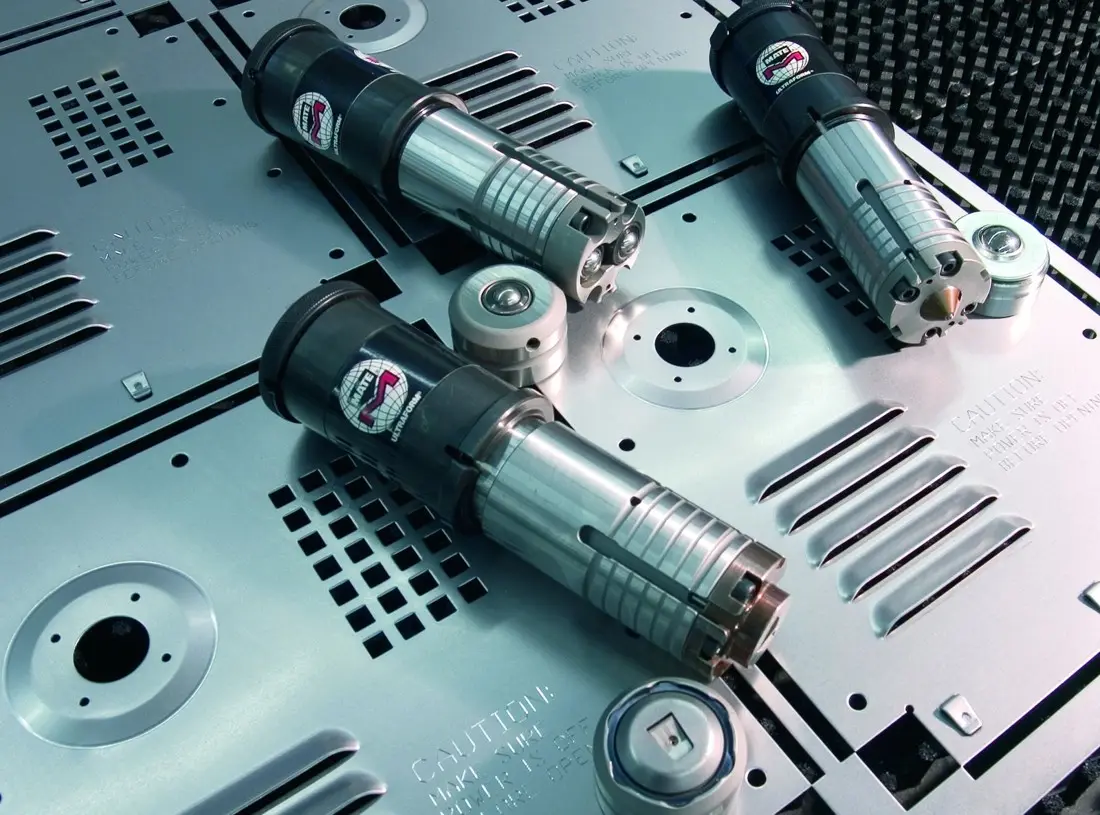
Tooling cost is one of the largest recurring expenses on a CNC punch press. Correct maintenance isn’t optional: it’s the direct difference between a tool that lasts several times longer and one replaced prematurely. What follows applies regardless of who made the tooling; where we have a specific Mate recommendation, we call it out separately.
When to sharpen a tool
Three signals tell you when a tool needs sharpening:
- The cutting edge radius. Check the punch and die edge visually, or with a loupe, at every tool setup. Mate’s own catalog recommendation is to sharpen once the edge radius reaches about 0.13 mm, not later.
- The quality of the punched hole. A burr that’s noticeably larger than normal on recently punched parts is the clearest sign the tool has dulled.
- The sound during punching. A dull punch makes a distinct sound compared to a sharp one; experienced operators learn to recognize it before it shows up as a problem on the part.
Why frequent small regrinds beat one large regrind
The underlying principle: a tool left to dull significantly, then sharpened once with a large stock removal, loses more usable material than the same tool sharpened several times, in small increments, at the first signs of wear. Mate’s own catalog confirms exactly this principle. Frequent touch-up sharpening works better than waiting for the punch to become very dull. The tool lasts longer and cuts cleaner, with less punching force. In practice, check your tools often and sharpen them early, rather than waiting until it becomes a visible problem on the part.
The correct sharpening procedure
For both punches and dies, Mate’s recommended procedure:
- Clamp the tool on a surface grinder’s magnetic chuck, properly supported (a V-block for round punches).
- Remove no more than 0.03–0.05 mm per pass, to avoid overheating the edge.
- Total stock removal per sharpening is typically 0.13–0.25 mm.
- Use coolant throughout the process.
- After grinding, stone the edge lightly to remove grinding burrs and leave a small 0.03–0.05 mm radius. This reduces the risk of chipping on the first strokes.
- Demagnetize the tool and apply a light coat of oil to prevent corrosion in storage.
Dies follow the same procedure. Check die thickness after every sharpening and compensate with shims as needed, so punch penetration into the die stays within spec.
What the slug tells you about die clearance
The waste piece from punching, the slug, is essentially a mirror image of the hole. If die clearance is too large, the slug shows a rough, undulating fracture edge with a small burnish zone. Checking slugs visually is a quick way to confirm whether your clearance is correct, without stopping production to measure. For the full formula and clearance table by material and thickness, see the die clearance guide.
Coatings and treatments for difficult materials
For applications where normal wear resistance isn’t enough, Mate offers two concrete options:
- Maxima™ coating: a multilayer Zirconium Titanium Nitride (ZrTiN) coating, hard and low-friction, applied to Mate’s premium tool steel punches. Recommended for 3000 and 5000 series aluminum, galvanized sheet, stainless steel, and materials where lubricant can’t be used (vinyl, pre-painted surfaces). Real-world test results cited by Mate: 2 to 10 times longer tool life.
- Nitride treatment: a heat treatment for high-speed steel (HSS) punches, recommended for abrasive materials (fiberglass) or materials that cause galling (stainless steel, galvanized steel, aluminum), and for high-speed punching. Not recommended for punches under 4 mm in diameter/width, for material thicker than 6.35 mm, or where the punch may deflect under load.
External factors that shorten tool life
Beyond sharpening and coating, a few external factors reduce the life of even a well-maintained tool:
- Machine alignment between punch and die, checked regularly, especially on turret machines.
- Wear on the bushings and guides that hold the tool in the machine.
- Lubrication, ideally automatic and programmable, applied to punch, guide, and sheet.
- Tool storage: cleaned, lightly oiled to prevent corrosion, and organized so tools aren’t damaged between uses.
What to send us
For a tool and coating recommendation matched to your application, the fastest way is to send us:
- The material and thickness of the sheet being punched.
- Whether you’re seeing increased burr, material buildup on the tool, or accelerated wear.
- Approximate production volume (strokes per month).
- The make and model of your punching machine.
Compatibility checks are free and come with no obligation, before any quote.
See the full Mate CNC punching tooling range → How to choose the right die clearance → Contact us for a recommendation →
Source: Mate Precision Tooling technical catalog (“Punch and Die Maintenance”, “Maxima™ Coating and Nitride Treatment”, “Tips and Techniques”), for the sharpening procedure, coatings, and external factors. Updated: August 24, 2026.