
Maintenance & operation Press brake tools
Press brake tool maintenance: corrosion, buildup, and rated force
How to prevent corrosion, material buildup on the tool edge, and exceeding rated force, the three most common causes of premature wear on press brake tooling.
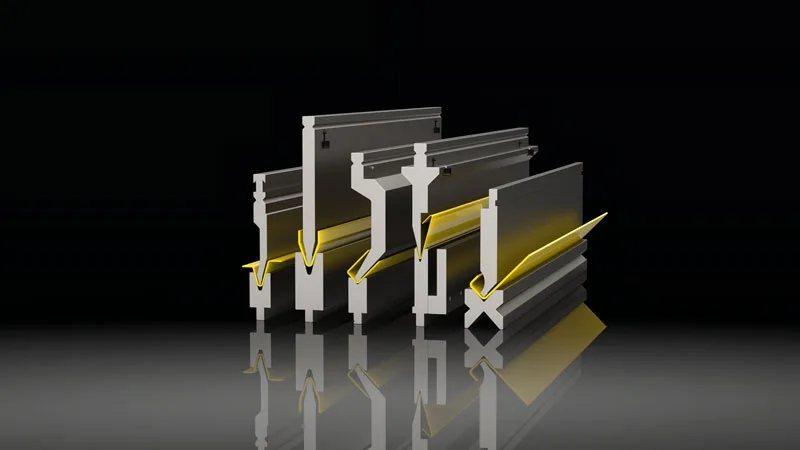
Unlike punching tools, press brake tooling isn’t periodically sharpened. Premature wear usually comes from somewhere else: corrosion, material buildup on the edge, or forcing the tool past its rated limit. All three are easy to prevent with simple practices, regardless of who made the tooling.
Corrosion: the most common cause, and the easiest to prevent
Moisture from bare hands, left on the tool surface during setup or changeover, causes corrosion over time. A few simple habits eliminate most of the risk:
- Wear gloves when handling tools.
- Clean the tool, at least the working area, with a lightly oiled cloth once per shift.
- Apply a light coat of protective oil at the end of the shift or before storage.
- Store tools that aren’t in use in dedicated cabinets, without stacking them on top of each other.
Material buildup on the tool edge
Repeated bending of galvanized sheet, aluminum, or edges already oxidized from laser cutting can leave a layer of material on the tool edge. This increases friction, affects bend quality, and over time wears the tool faster than normal use would.
For applications where this is a recurring problem, UKB offers solutions built specifically for it, already covered in the press brake tool selection guide: WingBend PLUS and UniBend dies with a Slider, which reduce direct contact and tool contamination, PU inserts and holders (Shore 80A / 90A / 95A), and universal protective films. The clamping rails on the press deserve the same attention: clean and lightly oil them regularly, the same as the tooling itself.
Rated force: check the limit before, not after
Every press brake tool has a maximum rated force per linear meter, given by the manufacturer (usually marked on the tool or stated in its documentation, in kN/m or t/m). Repeatedly exceeding that limit, even when the tool doesn’t fail immediately, shortens its life.
The force a bend requires depends on material, thickness, and die opening, not on the tool alone; the relationship between material strength (Rm) and actual bending force is covered in the UKB tool steel selection guide. As a reference point, for mild steel (Rm 510 N/mm²), a 90° bend in 1 mm sheet needs about 255 kN/m with a V4 die; the same thickness on a V16 die needs only about 40 kN/m. Always check the thickness-and-die-opening combination against the tool’s limit, not thickness alone. For a quick estimate on other material, thickness, and V-opening combinations, use the bend force calculator.
Rusted, scaled, or unlubricated sheet needs noticeably more bending force than the same sheet in normal condition, one more reason not to push a tool to its rated limit with unknown material.
What to send us
For a tool recommendation and a check of the force your application needs, the fastest way is to send us:
- The material, thickness, and condition of the sheet (new, galvanized, oxidized).
- The die opening you’re using or considering.
- Whether you’re seeing buildup, marking, or accelerated wear on your current tooling.
Compatibility checks are free and come with no obligation, before any quote.
See the full UKB press brake tooling range → How to choose press brake tooling → Contact us for a recommendation →
Source: UKB GmbH catalog for force specifications and special tooling solutions; general sheet metal tooling maintenance principles for corrosion, buildup, and storage. Updated: August 24, 2026.